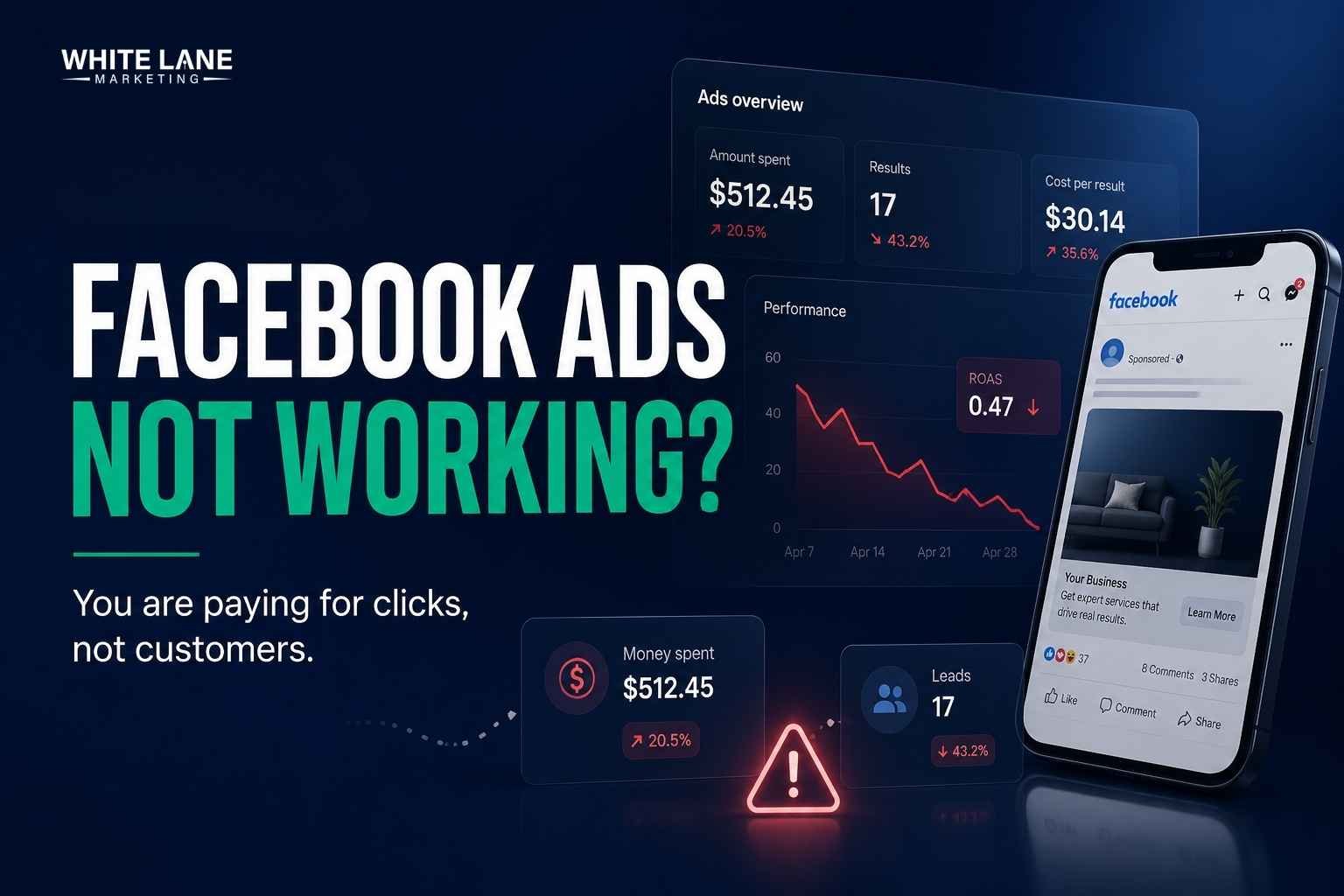
Most small business owners who try Facebook Ads share the same story. They set up a campaign, spend a few hundred dollars, get a handful of clicks but no real leads, and then conclude that Facebook Ads just do not work for them.
The platform is not the problem. Facebook Ads work. The harder truth is that every week a campaign runs without the right structure, you are paying to reach people and then losing them because of something entirely fixable. The issue is almost always in how the campaign was built.
This article covers the most common reasons small business campaigns fail and what a properly structured campaign actually looks like.
Facebook Ads Still Work in 2026. Here Is Why.
With over three billion monthly active users, Facebook remains one of the most powerful advertising platforms available to small businesses. What makes it genuinely useful is not just the scale but the targeting depth.
You can reach people based on age, location, interests, buying behavior, life events, and income brackets. You can retarget people who visited your website last week. You can build audiences that mirror your best existing customers.
No other platform at this price point gives you that level of precision. The businesses that figure out how to use it properly see consistent, measurable returns. The ones that run broad, untargeted campaigns do not.
The Real Reasons Your Campaigns Are Not Converting
Your audience is too broad
Selecting “all ages, all interests, entire country” is not a strategy. It spreads your budget across people who have no real interest in what you offer.
We have seen campaigns where simply narrowing the target audience by age range and location cut the cost per lead in half within the first two weeks. Defining your ideal customer precisely is the starting point for everything else.
You are sending traffic to the wrong page
Many businesses run ads that direct clicks to their homepage. The homepage is built for general visitors who are browsing. Ad traffic is different. These people clicked because something in your ad caught their attention, and they need a page that continues that exact conversation.
A dedicated landing page with one clear message and one clear action will consistently outperform a homepage for paid traffic. This is one of the most impactful and underused improvements in small business advertising.
Your campaign objective does not match your goal
Facebook asks you to pick an objective before launching. If you want leads but you optimize for engagement or traffic, the algorithm will find people who scroll and click rather than people who fill out forms.
Match the objective to the outcome you actually want. Lead generation campaigns should use the Lead or Conversions objective, not Reach or Brand Awareness.
You stopped the campaign before the algorithm learned
Facebook’s delivery system needs data to optimize. In the early days of a campaign, costs are higher and results are inconsistent. This is the learning phase. Pulling the campaign before it exits this phase means you never gave it a real chance.
A campaign typically needs 50 conversion events within a seven-day window to exit the learning phase and start performing efficiently. Many businesses give up at day three.
What a Campaign That Actually Converts Looks Like
Start with the offer, not the creative
Before you think about design or copy, ask: is what I am offering compelling enough to make someone stop scrolling? A weak offer cannot be saved by great visuals. A strong offer can often convert even with basic creative. That said, in 2026, with Facebook ad costs rising steadily across most industries, creative has become more important than ever. Research and experience from performance marketers consistently point to creative being responsible for 80 to 90 percent of campaign success. Your targeting and objective get people in front of your ad. But it is the video hook, the opening frame, or the single striking image that determines whether they stop or keep scrolling. Getting the creative right is no longer optional. It is where most of the work should actually go.
If you are promoting a free consultation, make the value of that session obvious. If you are selling a product, give people a clear reason to act now rather than later.
Use video where possible
Video content consistently outperforms static images for cold audiences on Facebook. A straightforward 30 to 60 second clip explaining what you do and who you help typically generates stronger engagement than a graphic alone.
If video is not an option right now, a clean image with a bold, specific headline still works. Test both formats and let the data tell you which resonates with your audience.
Write copy that leads with the problem
Your ad copy should open with the problem your customer has, not a description of your business. “Struggling to get leads from your website?” stops more people scrolling than “We offer digital marketing services.”
The headline carries most of the weight. If it does not create curiosity or speak directly to a real pain point, the rest of the ad will not matter.
Build a retargeting layer
Most people will not convert the first time they see an ad. This is normal consumer behavior. The businesses that extract the most value from Facebook Ads set up retargeting campaigns to follow up with people who have already shown interest.
Someone who visited your pricing page and left is a far warmer prospect than a cold audience member. A follow-up ad with a client testimonial or a limited-time offer will convert at a significantly higher rate and usually at a lower cost.
How Much Should You Actually Spend?
Facebook needs enough daily budget to gather meaningful data. Anything below $10 to $15 per day and the algorithm struggles to optimize. For lead generation targeting a specific local or national audience, a starting monthly budget of $300 to $500 gives you enough data to understand what is working.
Scale up once you have a campaign that is converting consistently. Scaling an untested campaign just increases the speed at which you lose money.
Simple Benchmarks to Know If Your Campaign Is Working
These are reasonable starting benchmarks for a small business lead generation campaign:
- Click-through rate above 1% suggests your creative and targeting are reasonably aligned
- Cost per click below $1.50 is generally healthy for most local markets
- Cost per lead consistently lower than the value of a new client means the campaign is profitable
If your numbers are significantly worse, the problem is almost always in the targeting, the creative, or the landing page.
Frequently Asked Questions About Facebook Ads
How much do Facebook Ads cost for a small business?
There is no fixed amount, but most small businesses starting out should plan for at least $300 to $500 per month in ad spend to gather enough data for proper optimization. Below this level, the algorithm does not have enough to work with and results are inconsistent.
How long before I see results from Facebook Ads?
Paid ads can produce leads within the first few weeks of a well-structured campaign. Unlike SEO, you are paying for visibility immediately. The learning phase typically takes one to two weeks. After that, a properly built campaign should start showing predictable results.
Why am I getting clicks but no leads?
This almost always comes down to the landing page or the offer. Clicks mean people were interested enough to act on the ad. If they are not converting after clicking, the page they land on is not continuing the conversation effectively, or the offer is not compelling enough to complete a form.
Do Facebook Ads work for service businesses?
Yes, particularly for businesses offering consultations, appointments, or clearly defined local services. The key is using the right objective, targeting people who match your ideal client profile, and sending them to a page built specifically for conversion rather than general browsing.
The Bottom Line
Facebook Ads are not a lottery. They are a system. When the targeting is precise, the offer is strong, the creative stops the scroll, and the landing page converts, the results are predictable and repeatable.
If you have run campaigns before and been disappointed, it is worth looking honestly at whether those campaigns had the right structure in place before writing off the platform entirely.
White Lane Marketing builds and manages Facebook Ad campaigns for small and medium businesses. If you want an honest assessment of what went wrong and what a properly built strategy would look like for your business, book a free consultation.

